

This fall, Smart Growth Maryland (SGM) attended conferences in Connecticut and Maryland that revealed a striking pattern. Speakers across disciplines – from insurance experts to faith leaders – were all describing the same set of solutions: build smarter, denser, and more equitable communities. Yet almost no one used the term Smart Growth. It seems to have slipped out of our national vocabulary. Smart Growth, the long-standing framework for sustainable, equitable growth, deserves to be at the center of the national conversation again.
At the YIMBYtown Conference in New Haven, CT, Dave Jones, Former Commissioner, California State Insurance warned of a growing insurance crisis and how extending growth in a sprawling manner was expensive. California has been impacted by growing intensity and frequency of wildfires, and the resulting costs of recovery are severe. Some insurers are no longer insuring properties, or reinsuring at high rates, which has implications for housing affordability. Jones also spoke of his work while he was in office enacting new regulations requiring transparency in the insurance industry, calling for insurers to divest from fossil fuel assets. With his appeal to curb sprawl and reduce development’s impact on natural resources, Jones was calling for a return to Smart Growth without saying those words.
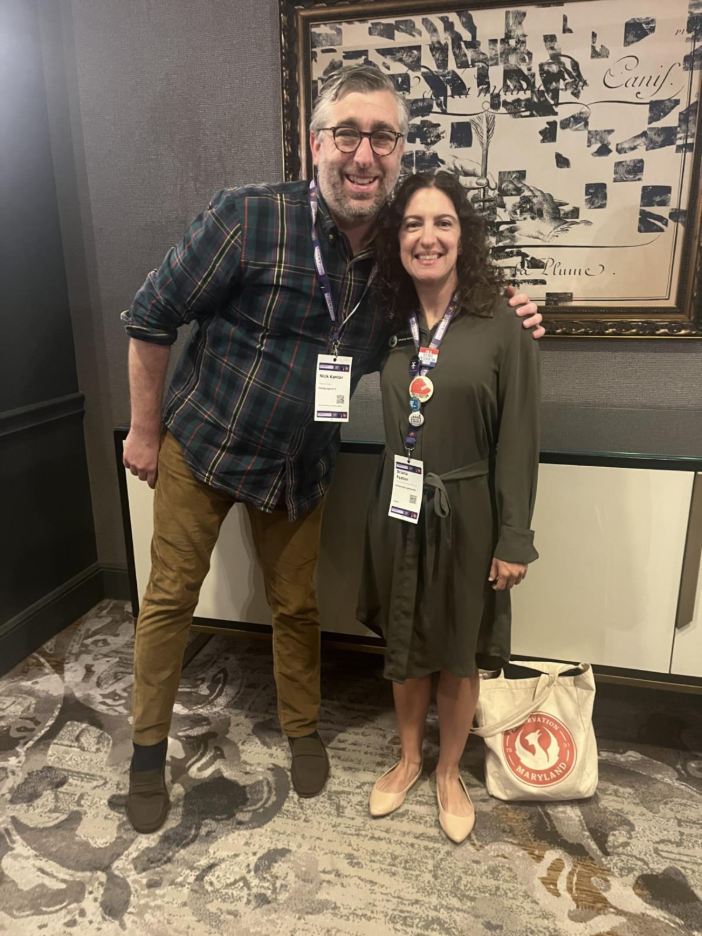
SGM’s Briana Paxton with Nick Kantor, Program Director of DesegregateCT, organizers of the YIMBYtown conference.
Other topics at YIMBY included state preemption laws recently passed in Massachusetts and Colorado that required municipalities to edit local zoning to allow for more housing types and density. In Massachusetts, a 2021 law impacted 177 Massachusetts Bay Transportation Authority (MBTA) municipalities that host or are adjacent to public transit. The regulations established a timeline for municipalities to adopt missing middle housing and multi-family housing edits to their zoning laws. As of 2025, 93% of municipalities are compliant or conditionally compliant. A few municipalities have launched lawsuits against the unfunded state mandate, citing fiscal concerns for how to pay for the public infrastructure needed to absorb more households. These debates highlight the ongoing tension between state-led mandates and local control, which is not limited to housing.
The topic of state preemption laws and the impact of local zoning on housing was also discussed in a session on organizing faith communities in housing reform. SGM’s Briana Paxton presented on a diverse panel including a congregation who attempted to redevelop their property into high density housing in Virginia, nonprofit faith organizers from VOICE and Open NY, and a developer who specializes in redeveloping faith-owned properties. Reverand Alice Towell shared how local zoning laws and procedures prevented her congregation from redeveloping their property in Arlington, Virginia, and they had to abort plans for housing and a new daycare facility. Jessica Sarriot with Virginians Organized for Interfaith and Community Engagement (VOICE) talked about the organizing power of faith communities which represent organized democratic bodies, organized fundraising, and organized advocates – all of which can be leveraged for housing advocacy. Paxton presented on a personal journey of spearheading a missing middle housing zoning reform in Savannah, GA and that sometimes an advocate can be the one to propose the solution. In Savannah, pro-homes advocates, preservationists, and faith communities came together to support the local affordable housing measure that was adopted in April 2025.
Back at home in Maryland, the Maryland Main Street Conference in Easton, MD featured a lively talk by Eastern Shore Land Conservancy Policy Director Owen Bailey, who humorously compared sprawl to donuts, a known source of empty calories, and highlighted downtowns as tacos, a highly versatile meal with nearly unlimited toppings that fit neatly in a compact, few bites. SGM’s Briana Paxton spoke on the discriminatory history of single-family zoning and called attention to local zoning issues like minimum lot sizes and parking requirements that prevent municipalities from rebuilding the existing buildings in their historic downtowns. Preservation Maryland President & CEO Nicholas Redding gave a rousing Tedx style talk on the final day of the conference calling for abundant preservation, stating that the point of preservation is not about the process, but the outcome of preserving communities and to aid in solving societies biggest challenges—like housing.
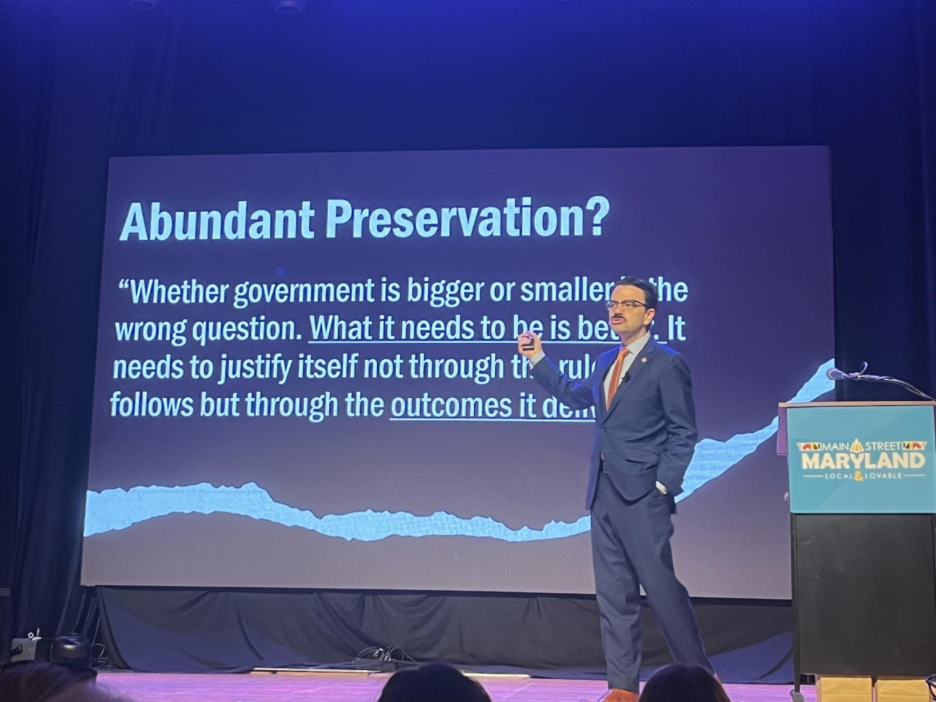
Preservation Maryland President & CEO Nicholas Redding speaking at the Maryland Main Street Conference.
The conversations happening in Connecticut, Virginia, and Maryland show that Smart Growth never disappeared – it just went unnamed. There is recognition across industries that sprawl is expensive, insurers are pulling back from risk, single-family only zoning is exclusionary, and local governments are struggling to maintain coffers. Yet, how we go about fixing that is still up for debate. State preemption laws are controversial, and the role of preservation needs clearer definition. Each of these efforts points toward a common solution rooted in Smart Growth principles – compact, connected, equitable communities. It’s time to recognize that Smart Growth isn’t a niche idea from the past; it’s the roadmap we need for the future.