
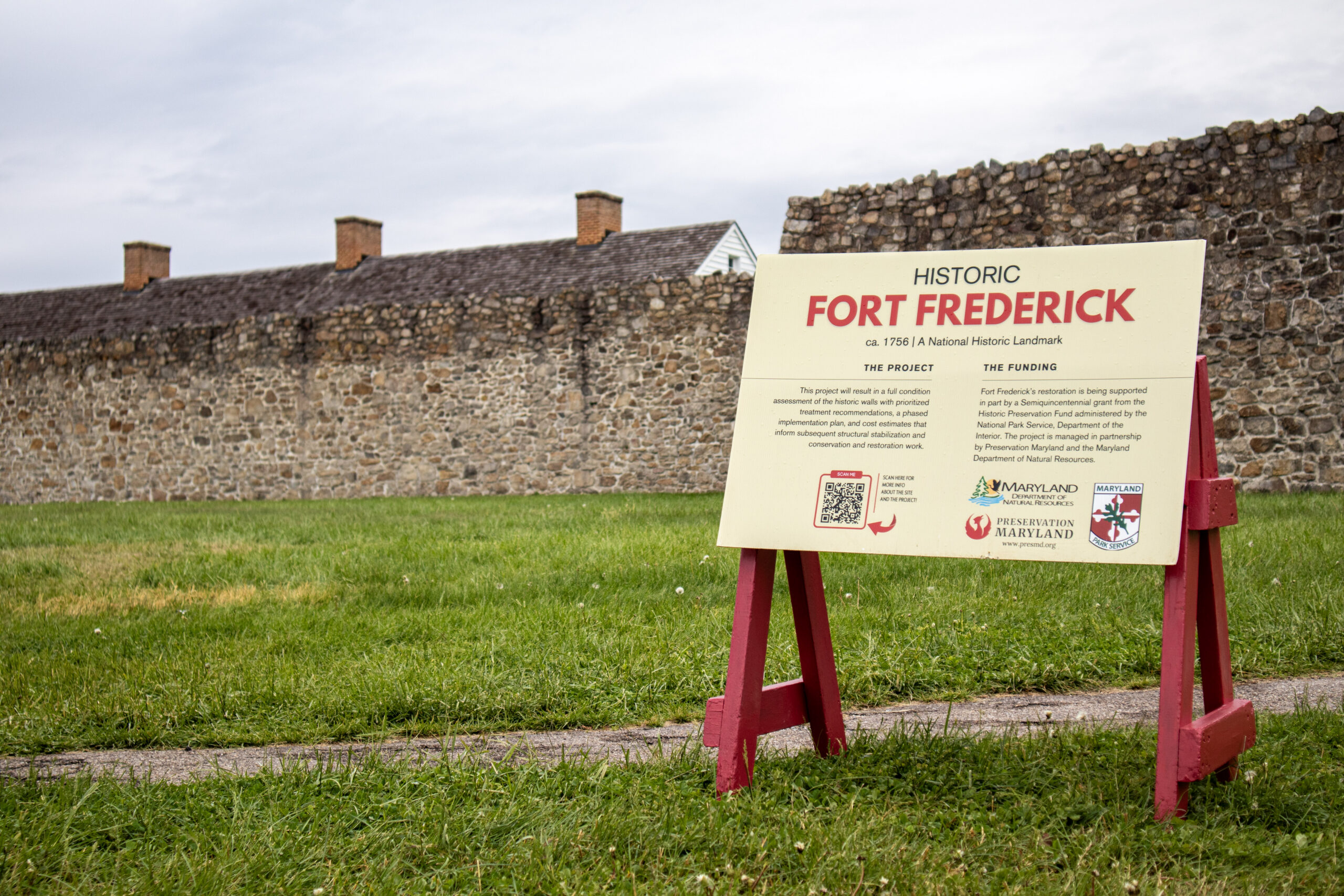
For more than 250 years, the stone walls of Fort Frederick have defined one of Maryland’s most remarkable historic landscapes. Enclosing the fort’s interior grounds, these massive walls remain one of the most intact examples of an 18th century stone fortification in the United States. Today, they continue to shape the visitor experience at Fort Frederick State Park—welcoming school groups, reenactors, and travelers who step inside for a glimpse back in time, as the fort has witnessed the nation’s evolving story since its construction in 1756 during the French & Indian War.
But even the strongest structures are not immune to the toll of time.
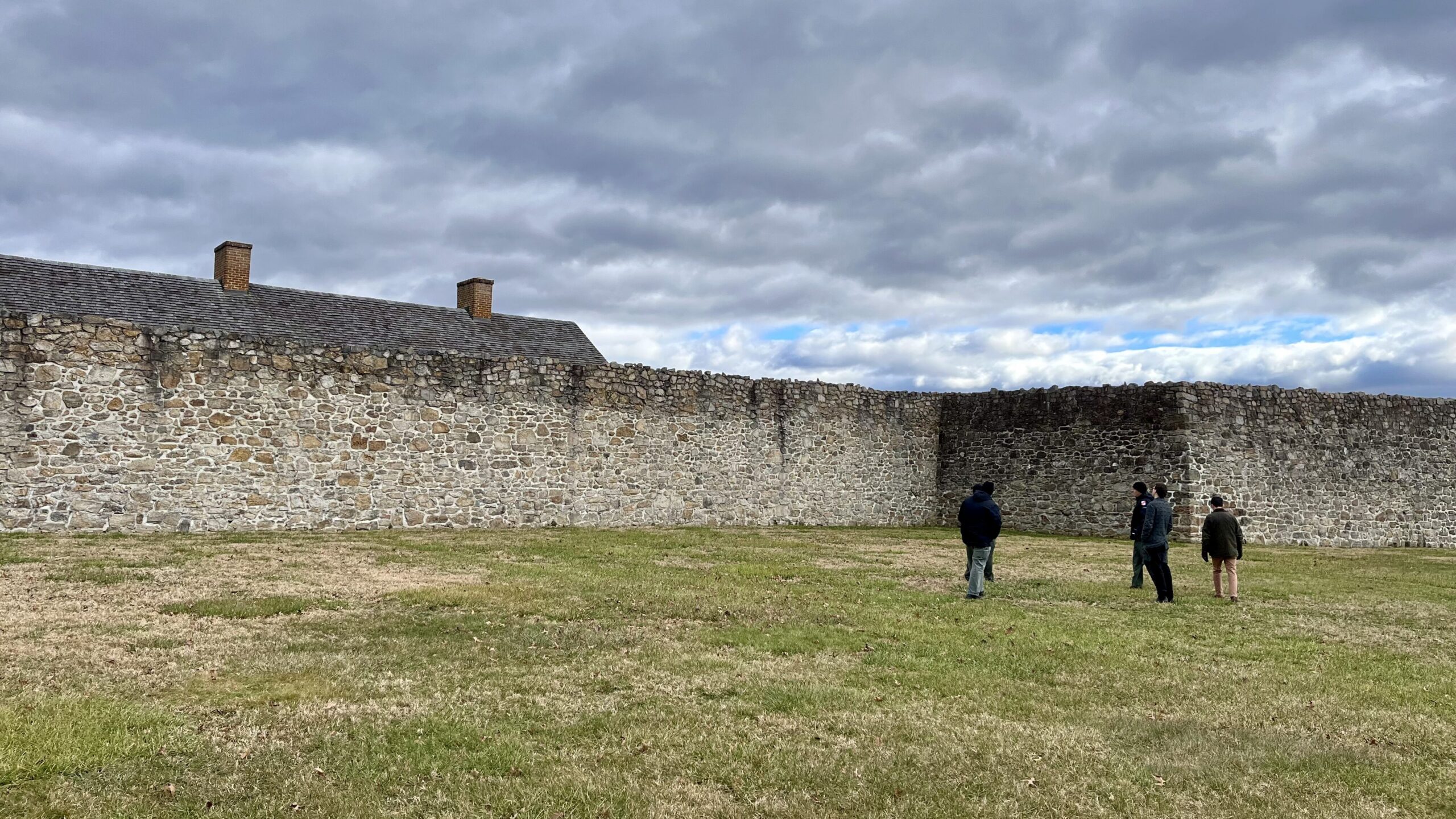
Preservation Maryland staff members stand among the 18-ft stone walls of Fort Frederick.
No Time Like the Present
Decades of weathering and environmental stress have left their mark on Fort Frederick’s stone walls. Mortar joints—those areas between the stones binding the masonry together—have eroded, allowing water to enter and expand during freeze-thaw cycles, accelerating cracking and deterioration. And, in some areas, earlier repairs using modern Portland cement mortar have worsened conditions by trapping moisture within the stone.
Much of this damage occurs beneath the surface, where water infiltration creates hidden voids and instability—meaning walls that appear sound may be quietly deteriorating from within. Left unaddressed, these issues will only worsen, leading to more complex and costly repairs over time.
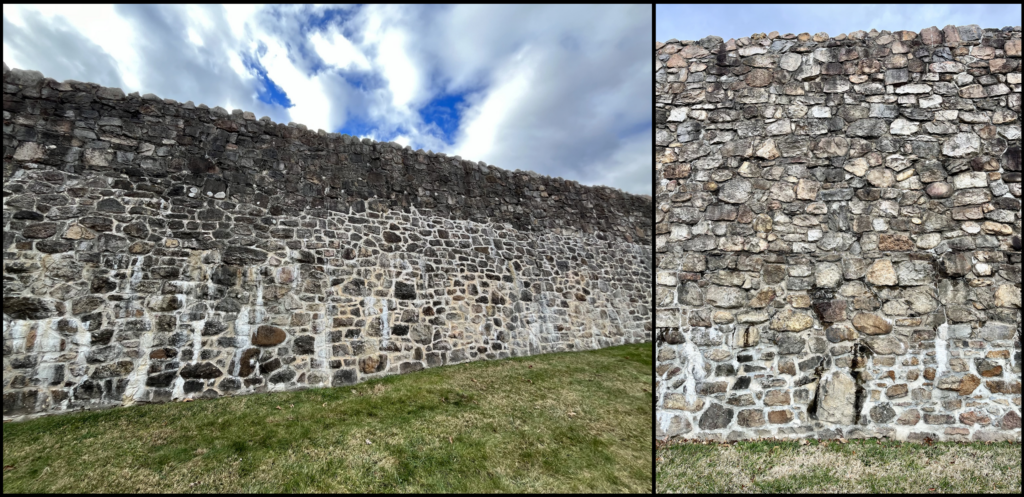
Examples of the walls’ current conditions, where prior repairs are failing.
As excitement builds for the 250th anniversary of the nation’s founding, Fort Frederick has an opportunity to shine with the stories ingrained within its centuries-old walls. While it served as a military outpost during the French & Indian War, Pontiac’s Rebellion, the American Revolution, and the Civil War, it also witnessed stories of freedom, enterprise, and community unfolding against the backdrop of a nation in flux. This milestone presents a timely opportunity to move beyond reactive fixes and undertake a comprehensive, long-term preservation effort.
Learn more about the fort’s history here.
A Phased, Collaborative Approach to Preservation
This effort is being led by Preservation Maryland in partnership with the Maryland Park Service—who owns and manages Fort Frederick State Park—who’ve sought out a specialized team consisting of Masonry Preservation Services, Inc. and Simpson Gumpertz & Heger to bring the project to life. Through a design-build approach, masonry expertise and structural analysis will be integrated from the outset—ensuring that work across planning, testing and construction documentation development, and restoration are closely aligned.
The overarching goal of the project is to preserve as much of the fort’s 47,500 square feet of stone walls as possible. This will begin with thorough planning work, including a hands-on condition assessment of the walls and bastions through such things as the use of selective probes to better understand internal conditions, and laser scanning and drone survey technology to create a precise record of existing conditions. This comprehensive understanding of the current conditions will help guide treatment strategies.
A key part of the process will be conducting pilot repairs and mock-ups. Before large-scale work begins, different repair methods and mortar compositions will be tested directly on a wall segment, allowing the team to evaluate performance and ensure that the final approach is both effective and appropriate for the wall’s historic fabric.
Once methods are refined and approved, restoration will proceed in phases, prioritizing the most vulnerable areas first. Much of the work will involve repointing—carefully removing deteriorated mortar and replacing it with new mortar compatible with the structure’s original construction. In select areas, damaged stones may be repaired or replaced, alongside improvements to better manage water infiltration over time.
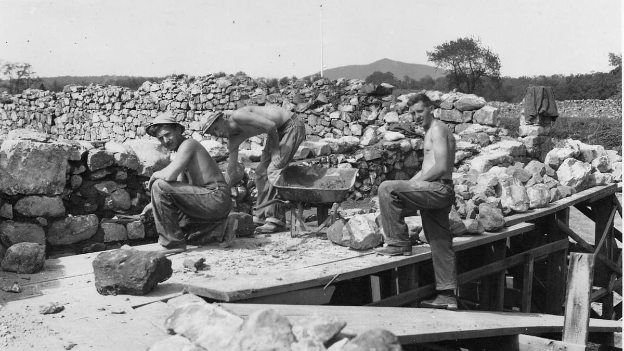
Members of the Civilian Conservation Corps among fort repair work in the 1930s. Today’s restoration work will look much different!
Looking Out for Long-Term Stewardship
While the project’s current funding will enable restorative repairs on the most endangered wall segments, the full scope of restoration will continue over time. The size and complexity of the fort’s walls require a sustained, phased effort—but each step builds toward a larger goal: comprehensive, long-term preservation.
Beyond immediate repairs, this work will produce valuable tools to guide future maintenance and investment, helping shift fort stewardship from reactive to proactive. Just as importantly, it ensures that Fort Frederick remains a safe, accessible, and meaningful place for the public—supporting educational programming, heritage tourism, and everyday recreation.
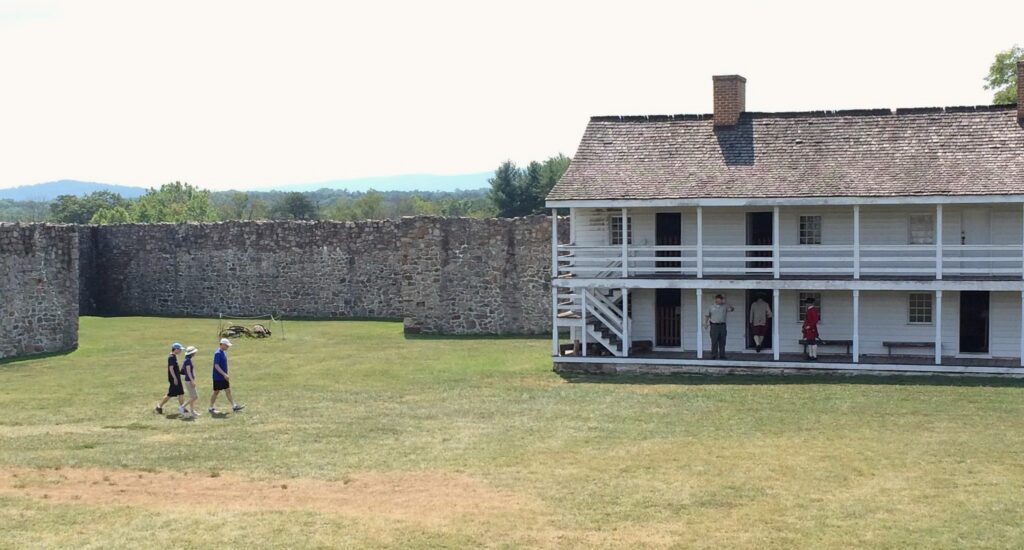
Visitors approach the historic barracks upon the parade ground at Fort Frederick. (Credit: Marc Tomik, Flickr)
Preserving the Past for the Future
The walls of Fort Frederick have stood for more than two and a half centuries—bearing witness to generations of history while continuing to serve the public today. Through careful planning, specialized craftsmanship, and a commitment to long-term stewardship, this project will help ensure they endure for another 250 years. It will not only protect a National Historic Landmark—it will sustain a place where people can connect with Maryland’s past in meaningful and lasting ways.
This work is supported in part by a Semiquincentennial grant from the National Park Service and Congressionally Directed Spending through the Historic Preservation Fund, along with matching support from the Maryland Department of Natural Resources.