
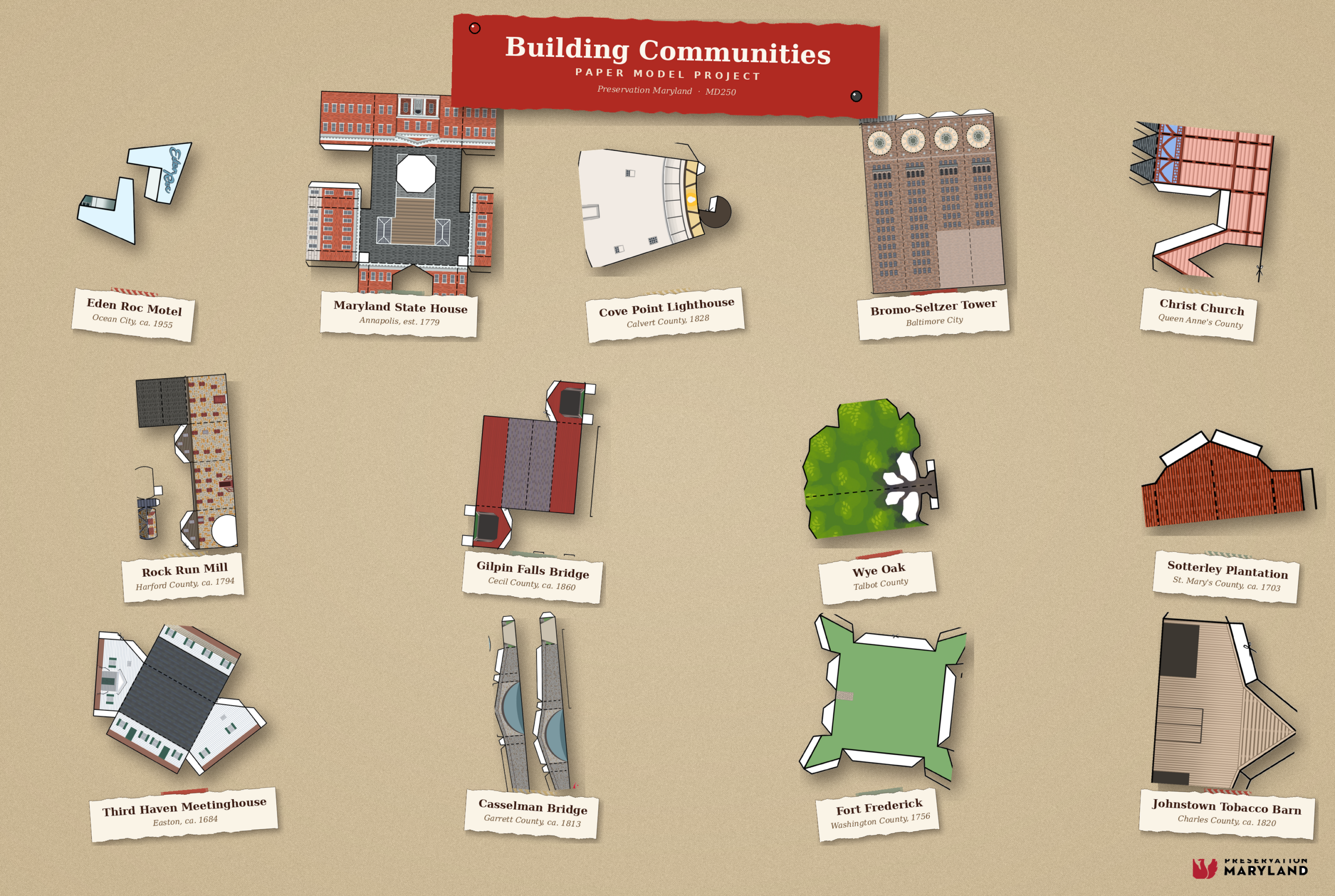
In 2023, Preservation Maryland launched Building Communities, an initiative designed to help Marylanders explore the state’s history and architecture through hands-on paper model construction. By combining accessible design with place-based storytelling, the program invites learners of all ages to engage with Maryland’s past through the act of making.
Printable on a standard home printer (we recommend cardstock for best results), these free downloadable models offer an engaging entry point into architectural history. Each model includes historical background information and easy-to-follow assembly instructions, making them ideal for classrooms, libraries, community programs, and home use.
With support from the Maryland Two Fifty Commission (MD250), Preservation Maryland is expanding the initiative to include representative historic structures from all 23 Maryland counties and Baltimore City, creating a statewide collection that reflects the people, places, and stories that have shaped Maryland over the past 250 years.
Click on the headings below to download a PDF of each model. We encourage you to build the model, then visit the real site. Share photos of your completed model and your visit on social media and tag Preservation Maryland.
Additional models will be released throughout 2026. Check back regularly as we expand the collection to include sites representing mid-century modern architecture, women’s history, African American heritage, maritime traditions, agricultural landscapes, and other stories that define Maryland’s rich and diverse history.

Allegany County: Fort Hill High School
ca. 1930 Fort Hill High School in Cumberland, Maryland, was constructed between 1934 and 1937 utilizing $600,000 in federal funding from two major Franklin D. Roosevelt New Deal agencies: the Public Works Administration (PWA) funded the main school building, while the Works Progress Administration (WPA) paid for the football stadium, tennis courts, and surrounding grounds

Anne Arundel County: Captain William Burtis House
The last remaining 19th-century waterman’s house on City Dock, the cottage was occupied by Capt. William Henry Burtis and three generations of his family before the City of Annapolis took ownership in 2022. Preservation Maryland is leading the stabilization of this dynamic climate resiliency project, a key component of the larger revitalization and resiliency plans for the historic City Dock as it continues to serve as the gateway to the Chesapeake Bay.

Anne Arundel County: Maryland State House
Designed by architect Joseph Horatio Anderson, the Maryland State House is the oldest statehouse in continuous use. It served as the United States’ Capitol in 1784 when the Treaty of Paris was ratified, officially ending the Revolutionary War. The building was restored in 2015, after which Preservation Maryland gave the restoration team their Stewardship Award.
In 1960, predating the National Historic Preservation Act, the National Park Service designated the Maryland State House a National Historic Landmark, one of the first in the nation. The State House Trust was established in 1969 to oversee the preservation of the State House buildings, grounds, and its interpretation to the public.

Anne Arundel County: Piscataway Woodland Period Building
Semi-permanent structures like this were constructed and used by Indigenous peoples in what is now Maryland for hundreds of years. Made from a variety of local materials including wood, small saplings, wovens matts, and grasses, buildings like these were used for storage and everyday life. Archaeologists are able find evidence of these structures by the marks they leave behind in the soil.

City of Baltimore: Bromo-Seltzer Tower
This iconic Baltimore structure was part of the Emerson Drug Company headquarters and manufacturing plant for the powder headache pain reliefmedicine Bromo-Seltzer. Today it houses The Baltimore Office of Promotion &The Arts.

City of Baltimore: Mount Vernon United Methodist Church
Built in the Gothic Revival style, the Mount Vernon United Methodist Church stands beside the Washington Monument in Baltimores historic Mount Vernon Place. Acquired by UNITE Mount Vernon Inc. in July 2025, the landmark will be preserved and adaptivelv reused as community hub with event space and mission-aligned commercial uses. The congregation will continue worshipping on-site, while the project supports the transformation of Mount Vernon Place into one of the nations premier urban parks. Preservation Maryland provided essential fiscal sponsorship.

Baltimore County: Temple Oheb Shalom
ca. 1956 Temple Oheb Shalom is one of Maryland’s oldest Jewish congregations, with roots dating to the mid-nineteenth century. Its modern sanctuary, completed in 1956, reflects evolving religious architecture and the growth of Baltimore’s Jewish community, while preservation of the congregation’s historic legacy highlights the cultural diversity that shaped Maryland communities.

Calvert County: Cove Point Lighthouse
ca. 1828 The Cove Point Lighthouse was established in 1828 to guide vessels navigating the Chesapeake Bay and the entrance to the Patuxent River. As one of the oldest continuously operating lighthouses on the Bay, the site preserves Maryland’s maritime heritage and demonstrates the importance of protecting historic navigation structures tied to the state’s coastal economy.

Caroline County: James H. Webb Cabin
The cabin housed the tree Black man,lames H. Webb and his recently freed wife, Mary Ann, along with other family members. The original foundation of the house remains with the rest naving been reconstructed. It IS the only remaining house on the Hastern Shore built by a free Black person before the Civil War. The Webb Cabin is owned and maintained by the Caroline Historical Society, and is one of more than 30 sites on the Harriet Tubman Underground Railroad Byway.

Carroll County: Union Mill
ca. 1797 Union Mill is a historic grist mill that illustrates the importance of agricultural processing in rural Maryland communities. Powered by water and serving local farmers for generations, the mill reflects early industrial development and the preservation of working landscapes that shaped Maryland’s economy.

Cecil County: Gilpin Falls Covered Bridge
Gilpin Falls Covered Bridge is one of Maryland’s few surviving covered bridges and represents nineteenth-century timber bridge engineering. Preservation of the bridge protects an increasingly rare type of historic infrastructure and offers insight into the transportation networks that once connected rural communities and commerce.

Charles County: Johnstown Tobacco Barn No. 2
The Johnsontown Tobacco Barn No. 2 is an early-19th-century tobacco barn that provides evidence of the first use of fires for curing tobacco. The barn was constructed c. 1820 at the edge of an agricultural field on the north side of Johnsontown Road near LaPlata, Maryland. The barn is significant as one of only a few documented tobacco barns in Southern Maryland with evidence of the fire-curing process.

Dorchester County: Stanley Institute
The Stanley Institute. previously called the Rock School, is an early post-Civil War African American school built and run independently by the local Black community. It was used as a school house until 1966 and is listed on the National Register of Historic Places. Today it is the 7th stop on the Harriet Tubman Byway, a self-guided driving tour that covers 45 sites related to the Underground Railroad.

Frederick County: Berlin House
Originally deeded in 1787. the house is one of twelve buildings that predate the current town name Brunswick, which was previously known as Berlin prior to 1890. Preservation Marylands Historic Property Redevelopment Program is currently working with the City of Brunswick on its rehabilitation into a community heritage space.

Garrett County: Penn Alps Inn & Craft House
ca. 1931 Penn Alps Inn & Craft House began as a roadside stop along the historic National Road and became a destination celebrating Appalachian crafts and hospitality. The site reflects the rise of automobile tourism in the twentieth century, and its preservation supports the continuation of regional craft traditions and cultural heritage in Western Maryland.
Coming Soon!

Harford County: Rock Run Mill
In continuous operation until 1954, the mill is a contributing resource to the Lower Deer Creek Valley National Historic District. located within SusquehannaState Park in Havre De Grace, Maryland. Preservation Marvland is currently working alongside the Maryland Park Service on the restoration of this vital resource that foreshadowed the rise of American industry in the 19th century.

Howard County: Howard County Courthouse
Located in the Ellicott City Historic District, this two-story Romanesque Revival structure dates back to 1851 and 1878. The property holds over 170 years of sobering but noteworthy American history as a site of African American captivity, extrajudicial injustice, and civil rights violations while also standing as a testament to the effects of unsympathetic development and climate change.
Preservation Maryland is working closely with Howard County to adaptively reuse the site and activate the area.

Kent County: Sumner Hall
ca. 1908 Sumner Hall was established by African American Civil War veterans of the Grand Army of the Republic as a meeting hall and community center. One of the nation’s few surviving Black veterans’ halls, the site preserves important stories of African American military service, civic leadership, and community organizing in Maryland history.

Montgomery County: Wire Hardware Store
The original structure was built in 1884, close to the new B&O Railroad that supplied its goods. After being destroyed by a fire it was rebuilt to be fireproof, including its iconic cast iron storefront. The building was the first recipient of a heart bomb, a fundraising strategy that engages local communities in the preservation of historic buildings. It is now maintained as part of the Rockville Historic District.

Prince George's County: Poplar Hill
Built in the late 18th century, His Lordship’s Kindness—also known as Poplar Hill—is one of Prince George’s County’s best-preserved Georgian plantation houses. Built around 1785, this brick manor reflects Maryland’s transition from the colonial era to the early years of the United States. Its well-preserved architecture offers a glimpse into the lives of the families who lived thereand the enslaved people whose labor sustained the plantation, making it an important place for understanding the county’s complex history.

Queen Anne's County: Centreville National Bank
The Centreville National Bank of Maryland was estsblished in 1876 and constructed its headquarters in 1904 to replace a previous
that was destroyed by fire. The building is now part of the Centreville Historic District.

Queen Anne's County: Christ Church
The congregation that built the church was first established at Claiborne’s settlement at Kent Pointe in the 1630s and is recognized as one of the oldest congregations in the state. Queen Anne’s County purchased the property in 2003 and its docents are members of the members Kent Island Heritage Society.
Somerset County: Ward Brothers House & Shop
Ca. early 20th century, the Ward Brothers House & Shop was home to Lem and Steve Ward, renowned Chesapeake Bay decoy carvers whose work elevated waterfowl carving into a celebrated American folk art tradition. Preservation of the property honors Eastern Shore craftsmanship and protects a tangible connection to Maryland’s maritime and cultural heritage.
Coming Soon!

St. Mary's County: Historic Sotterley Plantation
Sotterley is a campus of historic structures and is considered one of the oldest standing plantations in the U.S. It is also recognized by the UNESCO Roultes or Enslaved reoples Project as one of 31 Middle Passage arrival sites in the country. Today. Sotterley is the only tidewater plantation open to the public. It is a non-profit public charity governed by a Board of Trustees.

Talbot County: Third Haven Meeting House
Ca. 1684 Third Haven Meeting House is one of the oldest surviving Quaker meeting houses in the United States. Established in the seventeenth century, the site reflects the influence of Quaker communities in colonial Maryland, and its preservation safeguards an exceptionally rare example of early religious architecture and worship traditions.
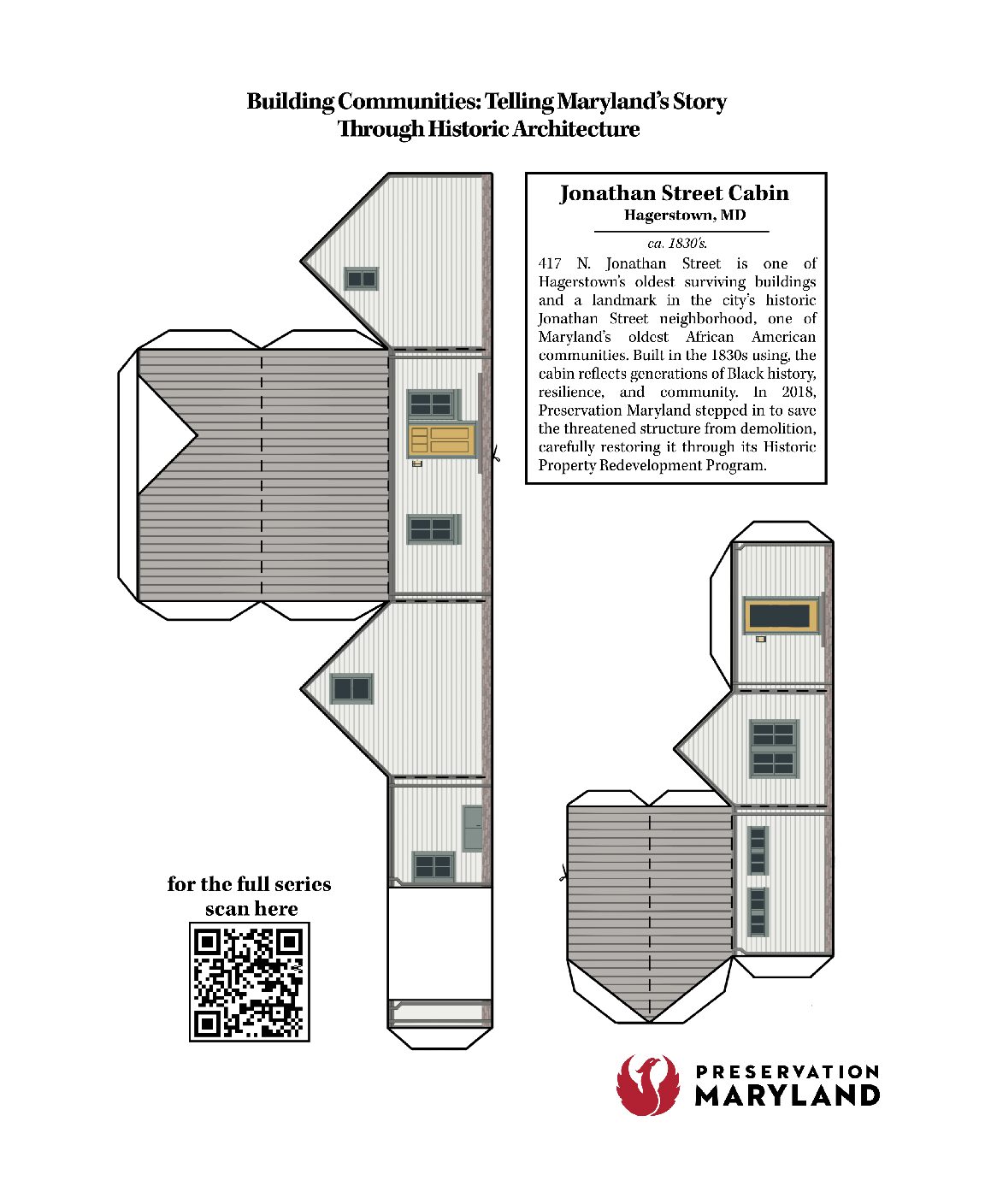
Washington County: Jonathan Street Cabin
417 N. Jonathan Street is one of Hagerstown’s oldest surviving buildings and a landmark in the city’s historic Jonathan Street neighborhood, one of Maryland’s oldest African American communities. Built in the 1830s using, the cabin reflects generations of Black history, resilience, and community. In 2018, Preservation Maryland stepped in to save the threatened structure from demolition, carefully restoring it through its Historic Property Redevelopment Program.

Wicomico County: San Domingo School
The San Domingo School was founded around 1886 to educate African American children in the San Domingo community on Maryland’s Eastern Shore following Reconstruction. The current school building, completed in 1919, is a Rosenwald School, funded through a partnership among the Rosenwald Fund, the local African American community, and public education officials. Designed according to plans developed through the Tuskegee Institute, Rosenwald schools brought improved educational facilities to Black students across the segregated South. The San Domingo School is one of the best-preserved Rosenwald schools in Maryland.

Worcester County: Eden Roc Motel
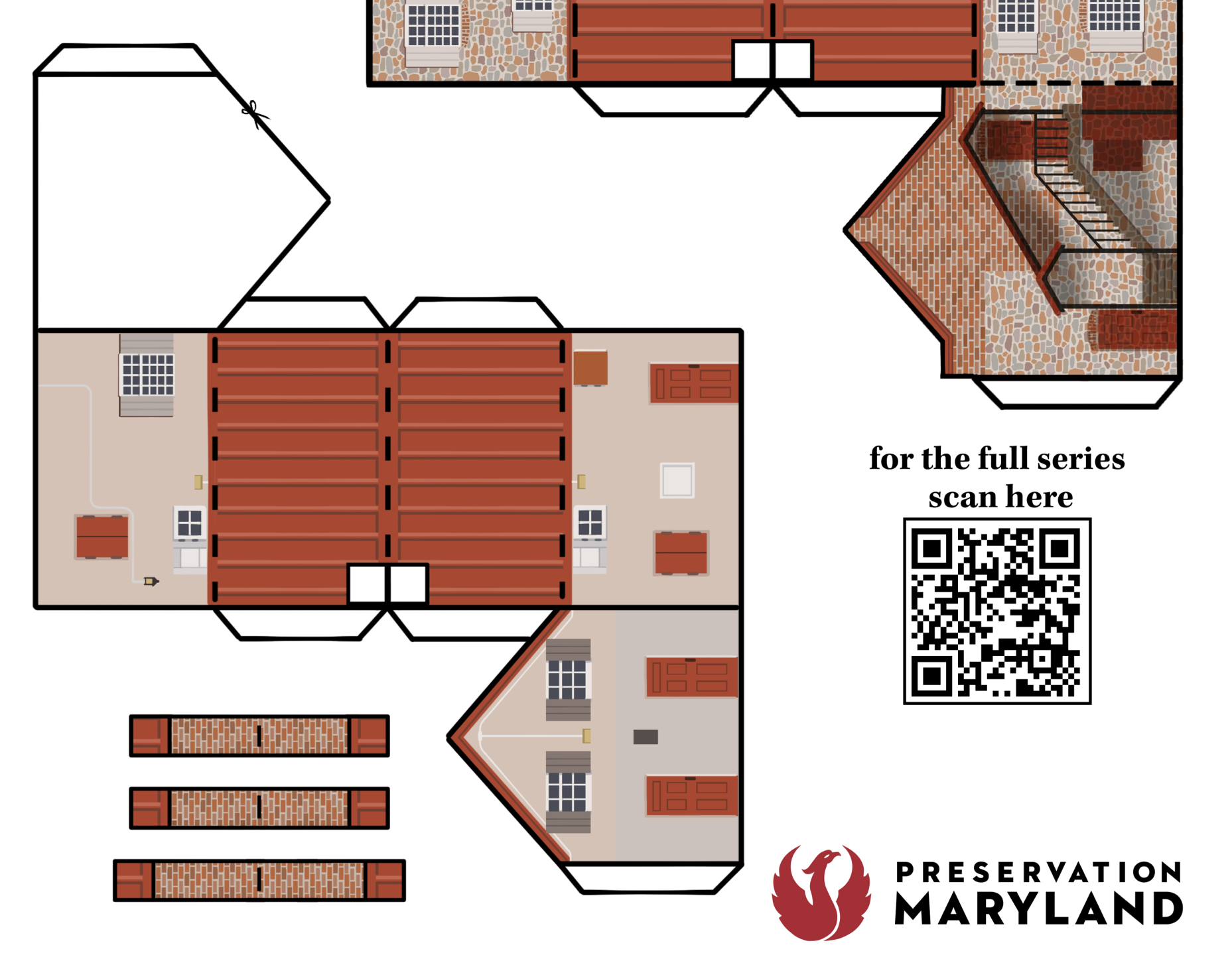
BONUS MODEL: Vechte-Cortelyou House
Two hundred and fifty years ago, Marylanders were part of a pivotal moment in the American Revolution, one that would become known as the Battle of Brooklyn. On August 27, 1776, thousands of American troops faced the much larger British and Hessian forces on Long Island. As the Continental Army retreated, a group of Maryland soldiers made a stand that bought time for George Washington and the rest of the army to escape. They became known as the Maryland 400.
Among the places associated with their story is the Vechte-Cortelyou House, a Dutch farmhouse in what is now Brooklyn’s Gowanus neighborhood, where Maryland troops fought to hold the area around the house as American forces retreated toward the East River. The Marylanders’ resistance came at a cost. Many were killed or captured, but their actions helped slow the British advance and gave thousands of Continental soldiers time to escape Manhattan. George Washington’s army survived to fight another day.

Contact Us
Preservation Maryland
3600 Clipper Mill Road
Suite 248
Baltimore, Maryland 21211
Phone
410.685.2886
Fax
410.539.2182
General: info@presmd.org
Media Inquiries: dcohen@presmd.org